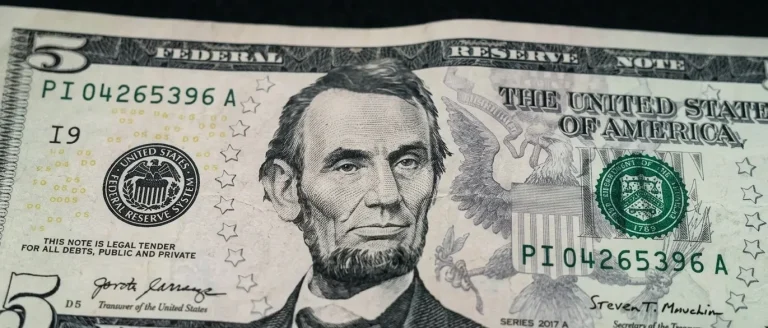
This 5 dollar bill featuring Abraham Lincoln represents an object of deep study due to serial number variability.
Digital combinations on a banknote determine uniqueness more than the physical paper condition.
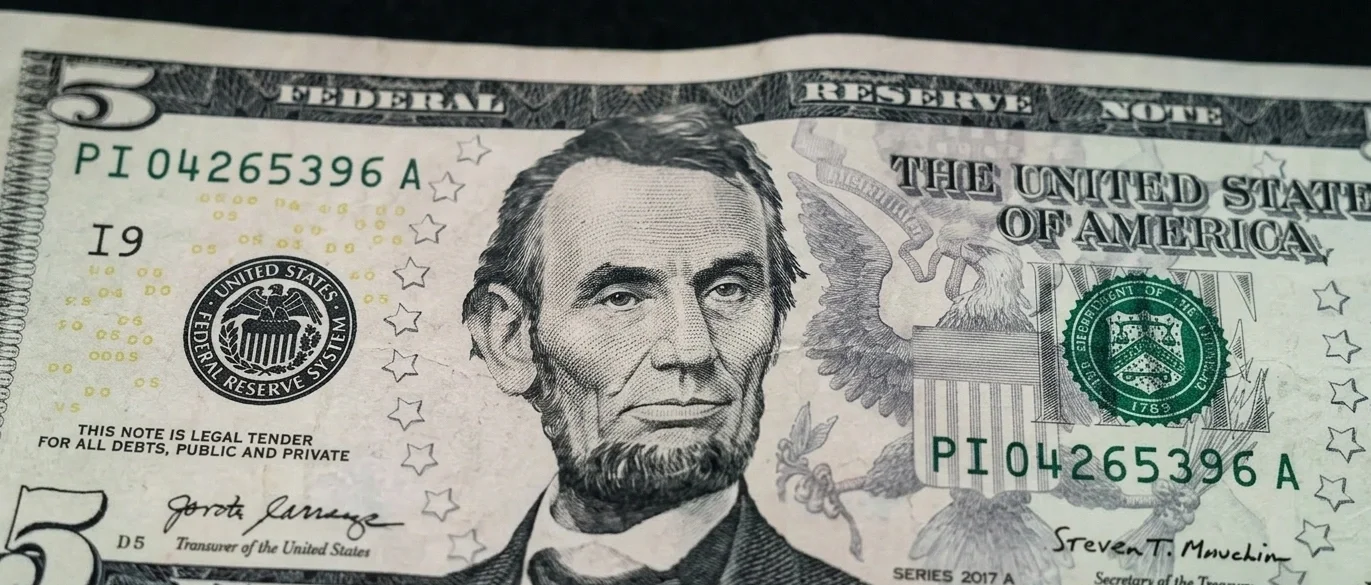
| Parameter | Value |
| Weight | 1.00 g |
| Length | 155.95 mm |
| Width | 66.29 mm |
| Thickness | 0.11 mm |
| Composition | 75% cotton and 25% linen |
| Primary Colors | Green, black, purple, gray |
| Portrait | Abraham Lincoln |
| Printing Method | Intaglio |
Classification of Rare Serial Numbers
A serial number consists of eleven characters.
The first letter indicates the series year.
Second letters identify the issuing Federal Reserve Bank.
Eight digits in the middle form the unique sequence number.
Final letters serve as a suffix.
Types of valuable combinations include low numbers ranging from 00000001 to 00000100.
Ladders consist of sequences like 12345678 or 87654321.
Radars read the same in both directions, such as 12344321.
Repeaters involve patterns like 12121212 or 45454545.
Solids feature eight identical digits like 88888888.
Binaries contain only two different digits, like 00550500.
Serial Number Influence on Market Price
Market value forms based on the scarcity of a specific digit sequence.
A standard bill from circulation costs 5 dollars, but some cost more, so check your bill with the coin appraisal app free.
Specimens bearing the number 00000001 might be valued at tens of thousands of dollars.
Price change statistics for rare numbers show a steady increase.
The growth reached 6 percent during the 2023 to 2024 period.
An increase of 8.5 percent was recorded from 2024 to 2025.
The current 2026 data indicates a further 11 percent rise.
Dynamics show a steady increase in interest regarding mathematically rare combinations.
Investment potential for such objects exceeds returns from standard bank deposits.
Auction Record for 5 Dollar Bills
| Number Type | Series | Grade | Sale Price |
| Low Number 00000001 | 2006 | PMG 67 Superb Gem Unc | $28,800.00 |
| Solid 99999999 | 1999 | PMG 66 Gem Unc | $12,500.00 |
| Ladder-Radar 01233210 | 2013 | PMG 64 Choice Unc | $4,200.00 |
| Super-Repeater 12121212 | 2017 | PMG 68 EPQ | $3,600.00 |
| Binary | 2003 | PMG 65 Gem Unc | $850.00 |
Price Depreciation Analysis Due to Defects
Paper condition directly affects the price coefficient applied to a rare number.
Presence of a center fold leads to a 30 percent price reduction.
Surface dirt causes a 15 percent value loss.
Mechanical edge damage results in a price drop of 50 percent or more.
Lack of PMG or PCGS Banknote certification implies a 20 to 40 percent discount from market price.
Characteristics of Star Notes
Replacement banknotes are printed to replace defective sheets.
A star symbol at the end of the serial number identifies them.
Combining a rare number and a star symbol creates extreme scarcity.
Print run size for star notes determines their value.
Runs under 640,000 units belong to the rare category.
Runs under 320,000 units belong to the very rare category.
Runs with 100,000 units or fewer belong to the ultra-rare category.
| Series | Bank | Replacement Run | Estimated Price |
| 1999 | L San Francisco | 640,000 | $120.00 |
| 2003 | G Chicago | 320,000 | $280.00 |
| 2013 | B New York | 128,000 | $650.00 |
Mathematical Probability of Digit Combinations
Finding a rare number in a standard 100 bill pack remains highly unlikely.
Such scarcity justifies the high premium over face value.
Solid probability is approximately 1 in 11,111,111 bills.
Radar probability is 1 in 10,000 bills.
Repeater probability is also 1 in 10,000 bills.
Rarity equals high price.
This formula serves as a fundamental principle in banknote collecting.
Design and Numbering Evolution
Since 1928, the five dollar bill design has undergone changes affecting serial number placement.
In 1999, digit size increased to improve reading by automated systems.
In 2008, a series featuring purple tones was introduced.
Numbering changes by year show a clear progression.
Small font and standard position were used from 1928 to 1995.
Enlarged font shifted toward the edge during the 1996 to 2006 period.
Integration into complex background patterns characterizes the 2008 to present era.
Factors Not Affecting Value
Certain traits are often incorrectly viewed as valuable.
Cleanliness of the series date does not impact price.
Bank districts generally remain neutral factors.
Professional evaluation excludes subjective factors.
Analysis relies solely on objective data from registries and auction records.
Price to Grade Ratio
| Grade | Description | Multiplier for Rare Number |
| 70 | Perfect Uncirculated | x10.0 |
| 67 | Superb Gem Unc | x5.0 |
| 65 | Gem Uncirculated | x2.5 |
| 58 | About Uncirculated | x1.2 |
| 20 | Very Fine | x0.8 |
Rare Printing Errors Combined with Numbers
Printing errors recorded by control authorities increase the value and can be determined with the best coin appraisal app.
An inverted serial number error occurs when one number is printed upside down.
Mismatched numbers show different digits on the left and right sides.
Number shift involves placement onto the portrait or watermark.
The price of a 2009 series note with mismatched numbers reached 2,500 dollars against a 5-dollar face value.
Exceeding the face value by 500 times confirms the significance of numbering defects.
Verification Procedure
Confirming authenticity and serial number value requires professional expertise.
PMG and PCGS Banknote lead the market.
A certified banknote features a sealed holder indicating all characteristics.
The certification process involves application submission followed by laboratory transport.
Grade assignment leads to registry number entry and return to the owner.
Having a registry entry prevents the sale of counterfeits with altered serial numbers.
Techniques involving laser digit removal and re-printing make verification mandatory.